
How Food Grade Silicone Products Companies Meet Global Safety Rules?

The food grade mold maker company in the USA must follow strict rules to ensure safety. The regulations act as a shield against dangerous chemicals that could be passed on to food.

The silicone can handle freezing cold and oven heat. Most people don't realise the extensive testing behind these simple kitchen tools. The safety checks happen at every step from raw materials to finished products.

Main Global Safety Standards

Many food grade mold maker company in the USA invest in testing labs and quality systems. These mold makers must navigate complex global standards.

Discuss your Requirement with our Experts

670+ clients served, Share your requirement in detail to get accurate quote

  1. FDA 21 CFR 177.2600 – U.S. Food Contact Requirements
    In America, this regulation clearly defines what materials can safely touch food. FDA testing monitors chemicals that may leach into foods during normal use. Manufacturers must prove their products will not transfer harmful substances.
  2. EU Regulation 1935/2004 – European Framework
    European regulations are among the strictest worldwide. This framework ensures that no unsafe substances transfer into food at any level. The CE mark indicates compliance with these rigorous European standards.
  3. GB 4806.11-2016 – Chinese National Standard
    This Chinese national standard focuses on composition limits and migration testing for silicone food contact materials. Many U.S. silicone mold manufacturers seek this certification, which requires detailed documentation.
  4. BfR Recommendations XV – German Guidelines
    These trusted German guidelines regulate silicone rubber used in food applications, with strict limits on volatile compounds and additives.
  5. ISO 9001 – Quality Management Certification
    ISO 9001 ensures systematic production, continuous improvement, and reliable quality management through regular audits.

Important Material Testing Requirements

The migration testing measures chemicals that might transfer from silicone into food. Labs simulate worst-case scenarios with food simulants like acidic liquids. Results must stay under strict limits for safety certification. The tests run for days under elevated temperatures.

Biocompatibility assessments check if materials cause biological reactions. These tests look for irritation, toxicity, and allergic responses. They involve both chemical analysis and sometimes biological testing. The methods align closely with medical device testing standards.

Temperature resistance testing proves products can handle kitchen conditions. Freezer-to-oven transitions create stress that can release chemicals. The products must perform safely from -40°F to over 400°F.

Microbiological testing checks if silicone harbours harmful bacteria over time. Many products shouldn't develop porous surfaces that trap food particles. The labs check if materials promote or inhibit bacterial growth.

Required Testing Parameters for Food Grade Silicone

Test Type Parameters Measured Acceptable Limits Testing Frequency
Migration Testing Overall migration < 10 mg/dm² Each new formulation
Extractables Volatile compounds < 0.5% Quarterly
Heavy Metals Lead, cadmium, mercury < 100 ppm (combined) Batch testing
Temperature Resistance Structural integrity -40°C to 230°C New product development
Sensory Testing Odor, taste alteration No detectable change Semi-annually
Colorant Safety Bleeding / migration No visible transfer Each color formula
5

Countries

11

Industries Served

756

Projects

264

Clients

food-grade-silicone-molds-manufacturing
  • Controlled Manufacturing Environment

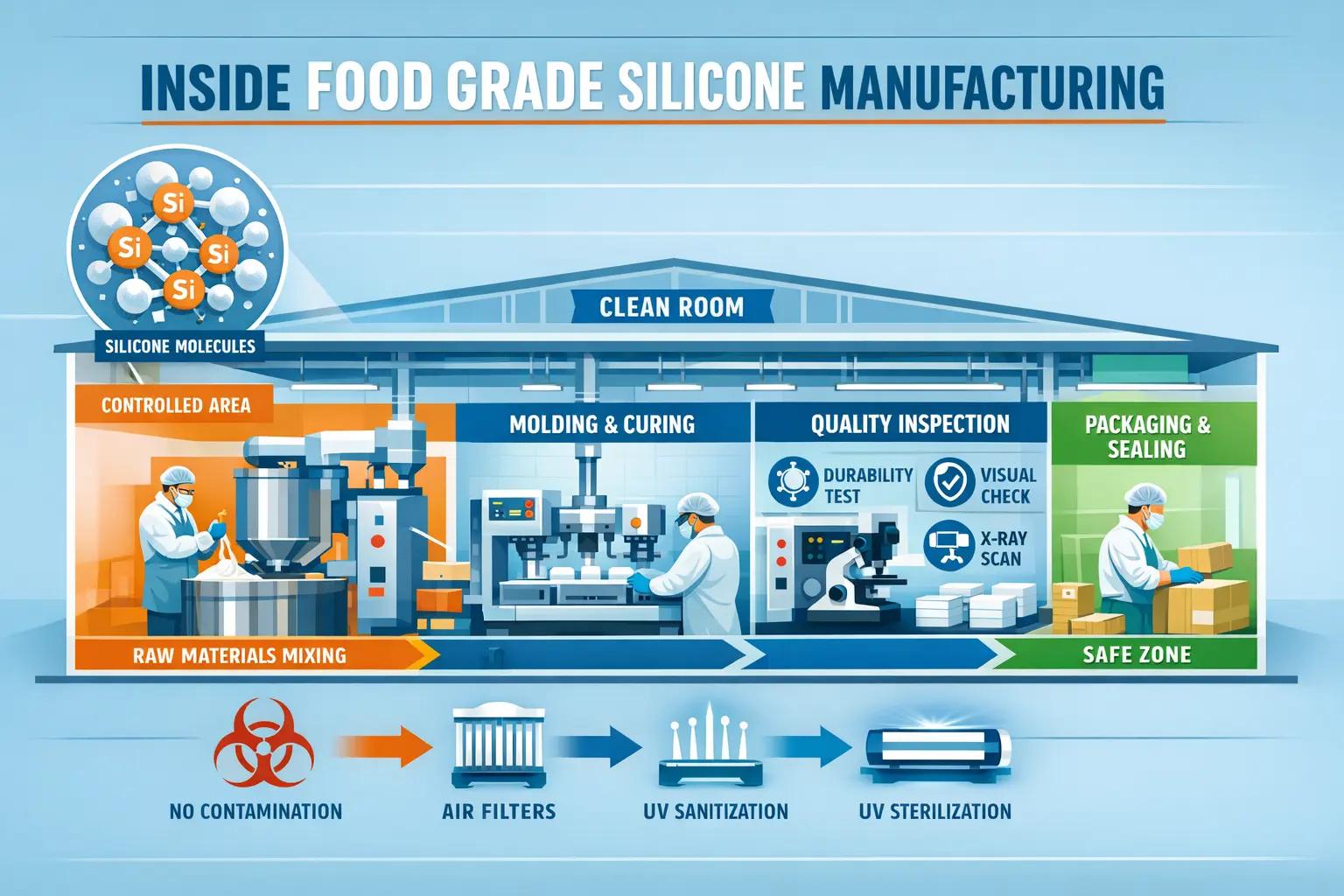
    Many facilities maintain controlled air quality and surface cleanliness. Engineers wear special protective clothing to prevent external contamination, while temperature and humidity remain within strict limits throughout the day. These controls prevent environmental contaminants from entering products during production.

  • Raw Material Verification

    Raw material verification takes place before production begins. Suppliers provide detailed certification for every batch, and materials are often re-tested in-house. Chemical fingerprinting technology confirms that each material precisely matches required food-safe specifications.

  • Batch Testing Protocols

    Each production batch is carefully tracked through the facility. Multiple samples from every run undergo comprehensive testing, allowing quick identification and isolation of any quality issues.

  • Cross-Contamination Prevention

    Dedicated equipment and production zones prevent cross-contamination. Colour-coded tools help workers instantly identify approved equipment, while separate ventilation systems stop airborne particle transfer. Cleaning validation is performed between different product runs.

  • Colour Additive Safety Verification

    All colour additives are verified to be food-safe. Modern pigments undergo extensive testing to eliminate harmful heavy metals, and only certified food-grade colourants are allowed in production areas.

  • Automated Defect Detection

    Automated quality control systems use computer vision technology to inspect dimensions and surface quality at high speed. Custom food-safe silicone molds undergo multiple inspection stages to ensure consistent quality.

FOOD GRADE INDUSTRY

Industries

What are the Certification Processes Done by Manufacturers?

There are numerous tests and checks done by various independent labs with no influence or bias from the company. The manufacturers also have relations with several testing organisations.

Every year, documentation and facilities, as well as processes, are audited. Many auditors review records of testing and quality control actions. They observe production processes in action without advance notice. These reviews typically last several days with detailed reports.

Documentation review protocols ensure complete records exist for everything. Every test and process change must be properly recorded. Food grade silicone products companies in the US maintain extensive files in their digital systems and protect these important records with backup security. The auditors specifically check documentation completeness during every visit.

Product quality testing frequency follows strict schedules at companies. Some tests occur daily, while others happen weekly or monthly. The schedule depends on risk assessment and past performance. The high-risk products undergo more frequent and thorough testing.

The renewal processes of the certification eliminate the use of aged silicone products. The majority of food safety certifications need to be renewed after a period between 1 and 3 years. The renewal process often includes new testing and facility inspection.

Conclusion

A reputable food grade mold maker company in the USA must follow strict safety rules and regulations. New regulations appear frequently as science discovers more about material safety. Most companies these days are sharing their safety data publicly online as a way of being fully transparent. The best makers exceed minimum standards rather than barely meeting them. Their testing goes beyond what laws require to ensure absolute safety. The special mixing techniques ensure colours stay put even during cooking. Proper curing times prevent unwanted chemicals from remaining in products. To learn about our safety testing and quality control processes, please call +1(647)-294-5240. For copies of our test reports and certifications, email info@foodsafesiliconemolds.com. We believe in complete transparency about our materials and manufacturing methods to give you peace of mind.

×

Get Ready to change your Product Vision into Realty...

Chat
X Get Free Consultation + CAD Design worth $500
Chat
X We are currently OFFLINE!
Please share your REQUIREMENT below and we'll get back to you!